
Shopping Cart
Nighttime Safety for Swimmers and Boaters: LED Lighting Placement Essentials
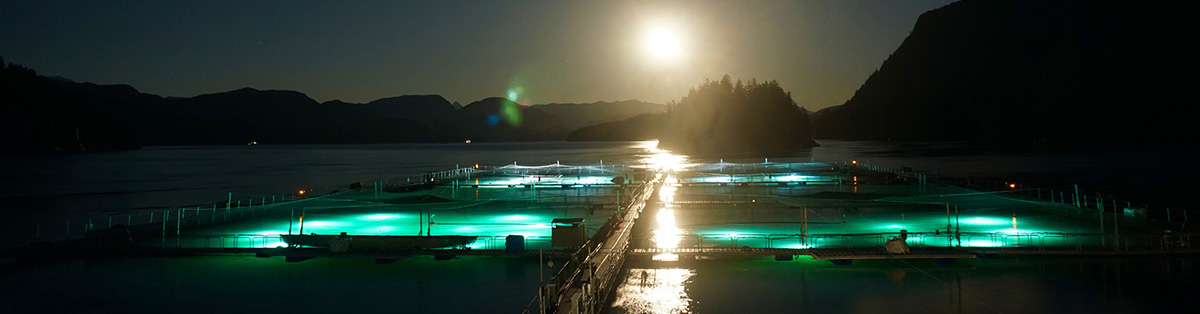
Waterfront living offers unparalleled beauty and recreation, but the onset of darkness introduces a set of unique hazards that every property owner must address. Whether you manage a busy commercial marina or enjoy a private residential pier, the safety of those in and on the water is a primary responsibility. Nighttime visibility is not just about aesthetics; it is a critical component of risk management.
Properly placed underwater dock lights serve as a visual guide for captains returning to their slips and a protective boundary for swimmers enjoying a late evening dip. Unlike traditional lighting, which often creates confusing glares or deep shadows, underwater safety lights allow for more accuracy. By understanding the essentials of lighting placement, you can create a secure environment that prevents accidents and enhances the functionality of your waterfront.
This guide explores the strategic implementation of LED systems to ensure maximum safety for swimmers and boaters, focusing on how the right equipment can transform a hazardous dark zone into a well-coordinated and secure facility.
The Critical Role of Visibility in Water Safety

The transition from day to night significantly alters depth perception and the ability to identify submerged objects. For boaters, the reflection of overhead lights on the water can create a shimmer effect that masks small obstacles like kayaks, swimmers, or floating debris. For swimmers, the lack of light beneath the surface can lead to disorientation or accidental collisions with dock pilings.
Strategic lighting placement aims to solve these issues by providing clear visual cues. When you utilize underwater LED lights, you shift the illumination from above the surface to within the water column. This reduces surface glare and allows for a clearer view of what lies beneath. In a safety context, visibility means the difference between a successful docking maneuver and an expensive hull repair, or between a safe swim and a dangerous encounter with a submerged hazard.
Overcoming the Refraction Challenge
Light behaves differently when it passes through the air-water interface. Traditional floodlights mounted on high poles often lose up to 30 percent of their effective illumination due to surface reflection. This reflected light is not just wasted energy; it actively contributes to “blinding” boaters. By placing the light source directly in the water, you bypass this refraction barrier. The light spreads more evenly through the liquid medium, revealing the true position of pilings and walls without the optical illusions caused by surface ripples.
Strategic Placement for Boating Safety

Navigation is the most significant challenge for boaters at night. Approaching a dock or entering a narrow channel requires precision that is often hampered by poor lighting.
Defining the Dock Perimeter
The most essential placement strategy for boaters is defining the edges of the dock. Linear LED strips or recessed puck lights should be installed along the rub rail or the outer edge of the decking. This creates a continuous line of light that allows a captain to judge the distance and angle of the dock from a distance.
Using underwater dock lights at the corners of the dock adds another layer of safety. These lights create a glowing end cap that is visible even in heavy rain or fog. By marking the extreme corners of the pier, you provide a clear target for the boater to aim for while maintaining a safe distance from the structure itself.
Marking Piling and Submerged Obstacles
Pilings are often the most common point of impact for vessels during nighttime docking. Placing LED fixtures directly on the pilings or using marine underwater lights at the base of each piling illuminates the vertical structure. This is especially helpful in tidal areas where the amount of visible piling changes throughout the cycle.
When a captain can see the entire vertical profile of the piling, they can better estimate the drift of their vessel and adjust their throttle accordingly. Furthermore, lighting the pilings from the bottom up ensures that the light does not shine directly into the captain’s eyes, preserving their natural night vision.
Channel and Hazard Identification
For larger properties or marinas, the path to the dock may be complicated by sandbars, rocks, or shallow zones. Underwater green lights are highly effective for marking these hazards. Because green light penetrates further through murky water, it can be used to create a liquid lane for boaters. Placing these lights at intervals along a channel edge provides a high visibility pathway that is much easier to follow than traditional unlit buoys.
Maximizing Safety for Nighttime Swimmers

Swimming at night is a popular luxury, but it requires a different lighting approach than boating. The primary goal for swimmer safety is to eliminate dark pockets where a person might become disoriented or go unnoticed by others.
Creating a Safety Halo
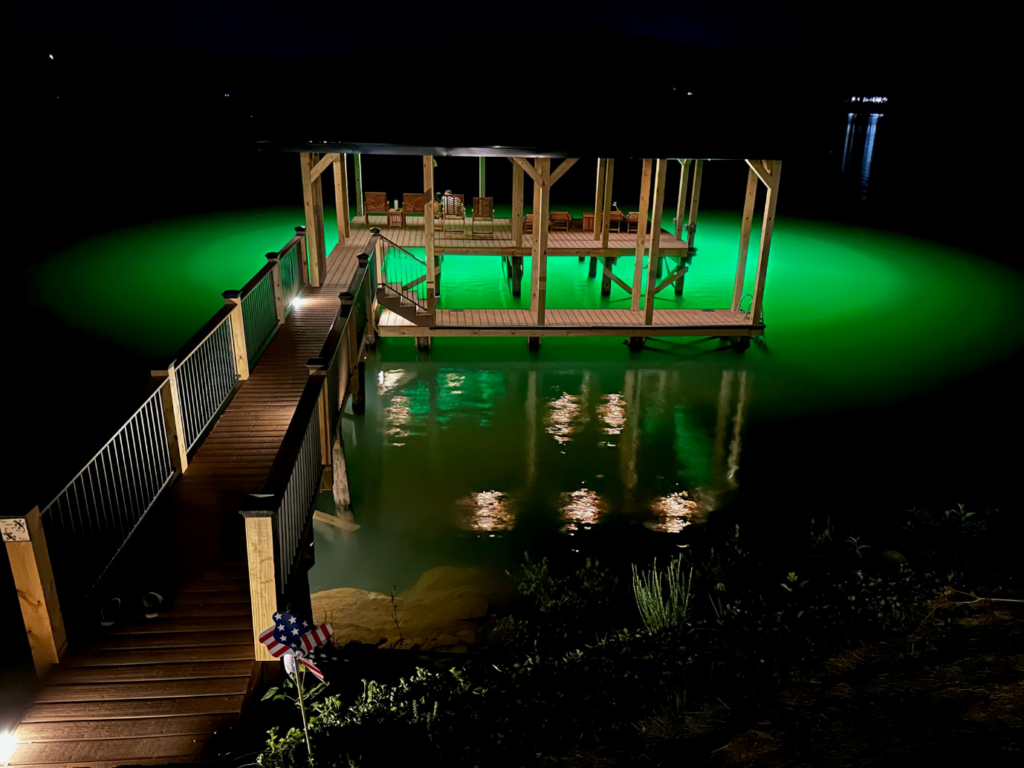
The most effective way to protect swimmers is to install underwater fish lights at regular intervals around the designated swimming area. These fixtures create a broad halo of light that extends several feet into the water. This ensures that the swimmer is always visible from the deck or the shore.
If a swimmer happens to dip beneath the surface, the light from below makes them much easier to spot than overhead lights, which often reflect off the surface and obscure anything submerged. This is a vital feature for parents or lifeguards monitoring the water at night.
Illuminating Exit Points and Ladders
Every swimming area must have clearly marked exit points. LED lights should be placed directly above and below any swim ladders or stairs. This prevents swimmers from struggling to find the exit in the dark and reduces the risk of slipping on wet, invisible surfaces.
Placing a high intensity LED fixture near the base of a ladder ensures that the swimmer can see exactly where to place their feet. In emergency situations, a well lit exit point can be a literal lifesaver, allowing for a quick and coordinated egress from the water.
Depth Perception and Bottom Clarity
Knowing the depth of the water is essential for preventing diving accidents. By using underwater LED lights to illuminate the seabed or the bottom of the swimming area, you provide a clear visual indicator of the depth. This also allows swimmers to see any natural hazards like rocks, sea urchins, or uneven terrain that could cause injury.
Why Color Choice Matters for Safety

The specific wavelength of your LED system is not just an aesthetic choice; it directly impacts how well people can see in different water conditions and remains the most critical factor in nighttime risk management.
The Superiority of Green for Murky Water
In the realm of maritime safety, underwater green lights are the undisputed gold standard for visibility in coastal or lake environments. For safety purposes, green light is ideal because it provides the furthest throw of light through sediment, algae, and organic tannins. If you are marking a hazardous area, a submerged rock pile, or a dock edge in brackish water, green LEDs will be visible from a much greater distance than any other visible wavelength.
This superior performance is due to the physics of the light spectrum. Green light sits in a “sweet spot” of the visible spectrum where it is least absorbed by the microscopic particles found in most natural bodies of water.1 This allows the light to travel further without scattering, creating a massive, luminous safety perimeter around your property. For boaters, this translates to a clear, unmistakable beacon that can be identified from hundreds of yards away, providing ample time for safe navigational adjustments.
Furthermore, underwater green lights provide a psychological advantage for swimmers. Because the human eye is naturally more sensitive to the green color band, the water appears clearer and depths become easier to perceive. This increased visual acuity helps prevent disorientation during nighttime swims and ensures that every submerged piling or ladder is sharply defined. By maximizing the “lumen throw” within the water column, green LEDs eliminate the dark pockets where accidents are most likely to occur, turning a potentially dangerous waterfront into a securely illuminated zone.
Technical Specifications: The Engineering of Safety

To maintain a safe environment, the hardware must be as robust as the lighting plan. In a comprehensive exploration of safety, we must address the specific engineering requirements of marine lighting.
Heat Dissipation and Circuit Protection
Underwater LEDs generate heat, though significantly less than halogens. In a marine setting, the water itself acts as a heat sink. However, if a light is left on during low tide and becomes exposed to the air, it can overheat and fail. High quality marine underwater lights include thermal cutoff switches that protect the circuitry. This prevents the fixture from becoming a fire hazard or simply burning out when the water level drops.
The Importance of Proper Gaskets and Seals
A safety light is only effective if it remains illuminated. Moisture is the primary cause of LED failure. Incredible Underwater LED Lighting utilizes double O-ring seals and marine grade silicone gaskets. These components ensure that even under the pressure of several feet of water, the sensitive internal electronics remain dry. When choosing fixtures, always look for an IP68 rating, which indicates the highest level of protection against long term submersion.
Power and Infrastructure: The Backbone of Safety
For a safety lighting system to be effective, it must be reliable. A light that fails during a storm or a power surge is a safety liability.
Low Voltage Systems for Water Safety
Incredible Underwater LED Lighting recommends low voltage DC systems for all dock and underwater applications. This drastically reduces the risk of electric shock in the water. Modern LED drivers are designed to handle the fluctuations in power that often occur at the end of long piers, ensuring that your underwater LED lights stay bright and consistent.
Marine Grade Materials
Corrosion is the enemy of safety. If a fixture corrodes and falls from its mounting, it becomes a submerged hazard itself. Using 316L stainless steel or solid brass ensures that the fixtures remain securely attached to the structure for decades. Furthermore, potted electronics prevent moisture from causing internal shorts that could lead to system failure when you need it most.
Smart Controls and Automated Safety Features
Motion Activation and Timers
In low traffic areas, motion sensors can be programmed to ramp up the brightness of underwater dock lights when a boat or person is detected. This provides a sudden increase in visibility when it is most needed while conserving energy during quiet periods.
Emergency Overrides
A centralized control system can include an emergency mode. In the event of an accident, a single button can turn every light on the property to 100 percent brightness. This provides immediate, maximum visibility for first responders and rescuers.
Advanced Placement: The Marina Context
Commercial marinas require a more complex grid of light than residential docks. In these high traffic environments, lighting must facilitate the movement of dozens of vessels simultaneously.
T-Head and Fairway Illumination
The ends of the piers, known as T-Heads, should be the most brightly lit areas of the marina. These are the primary navigational marks for vessels entering the facility. Using a combination of overhead bollards and underwater green lights at the T-Head ensures that the entrance is unmistakable from the main channel.
Within the fairways, the placement of underwater dock lights should be staggered. This prevents a “runway” effect that can be confusing and instead creates a series of soft pools of light that define the width of the channel between the slips.
Fuel Dock and Service Area Security
Fuel docks are high risk zones. Lighting here must be intense and clear. Utilizing explosion proof LED housings and high CRI lights ensures that staff can clearly see fuel levels, spillages, and line placements. This is where task lighting and safety lighting converge to protect both the facility and the environment.
Environmental Responsibility and Dark Sky Compliance
Safety lighting does not have to mean light pollution. By choosing directional LEDs and shielding overhead fixtures, you can keep the light focused on the water and the walkways without contributing to sky glow.
Using underwater LED lights is naturally more Dark Sky friendly because the water itself acts as a shield, absorbing the light and preventing it from shining up into the atmosphere. This allows you to maintain a high level of safety while respecting the local environment and the nocturnal wildlife that shares your waterfront.
Impact on Migratory Patterns
Excessive artificial light can disrupt the natural cycles of local fish and birds. By utilizing timers and dimmers, marina managers can reduce the “lumen load” during the late night hours when traffic is minimal, while still maintaining enough light for basic security and safety.
Conclusion: Investing in Peace of Mind
Nighttime safety for swimmers and boaters is achieved through a combination of high quality technology and strategic placement. By defining the dock perimeter, marking submerged hazards, and creating a luminous safety halo with underwater LED lights, you can significantly reduce the risk of accidents on your property.
Utilizing specialized tools like underwater green lights and marine underwater lights provides the visual clarity needed for complex navigation and safe recreation. Whether you are attracting marine life with underwater fishing lights or simply ensuring a safe return to the slip with underwater dock lights, every fixture contributes to a more secure and enjoyable waterfront experience.
Safety is the ultimate luxury. When you invest in a professionally designed LED system from Incredible Underwater LED Lighting, you are not just buying lights; you are investing in the peace of mind that comes from knowing your property is a beacon of safety for everyone who enjoys it.

Secure Your Waterfront with Premium LED Technology from Incredible Underwater LED Lighting
Protect your investment and your guests with the industry’s most reliable underwater LED lights. Our specialized underwater dock lights provide essential visibility for safe nighttime navigation, while our high-performance underwater green lights cut through the murk to identify submerged hazards. Whether you are creating a safety perimeter with marine underwater lights or a vibrant ecosystem with underwater fish lights, we offer the reliability and precision you need. Don’t leave your safety to chance in the dark. Visit Incredible Underwater LED Lighting today to browse our professional collection and illuminate your dock with confidence.
Frequently Asked Questions
1. How does underwater lighting improve safety for boaters compared to overhead lights?
Traditional overhead lights often reflect off the surface, creating a blinding shimmer that hides submerged hazards. By using underwater led lights, you illuminate the water from within, eliminating surface glare and providing a clear view of pilings, debris, and the dock’s true edge for safer docking.
2. Why are underwater green lights recommended for marking navigational hazards?
Green light waves travel most efficiently through the sediment and algae found in coastal or lake water. Underwater green lights provide the furthest visibility in murky conditions, allowing boaters to identify channel markers or hazardous rocks from a much greater distance than other colors.
3. Where is the most critical placement for lights to assist with nighttime docking?
For maximum safety, underwater dock lights should be placed at the extreme corners of the pier to define the perimeter. Additionally, installing marine underwater lights at the base of pilings allows captains to see the vertical structure of the dock clearly without being blinded by direct light.
4. Are these lighting systems safe to have in the water while people are swimming?
Yes, Incredible Underwater LED Lighting utilizes low voltage DC systems, which are specifically designed to minimize the risk of electric shock. These high-quality LEDs provide a bright safety halo that keeps swimmers visible to those on the dock, making nighttime recreation significantly more secure.
