
Shopping Cart
Marine Underwater Lights: What Waterfront Homeowners Should Know Before Buying
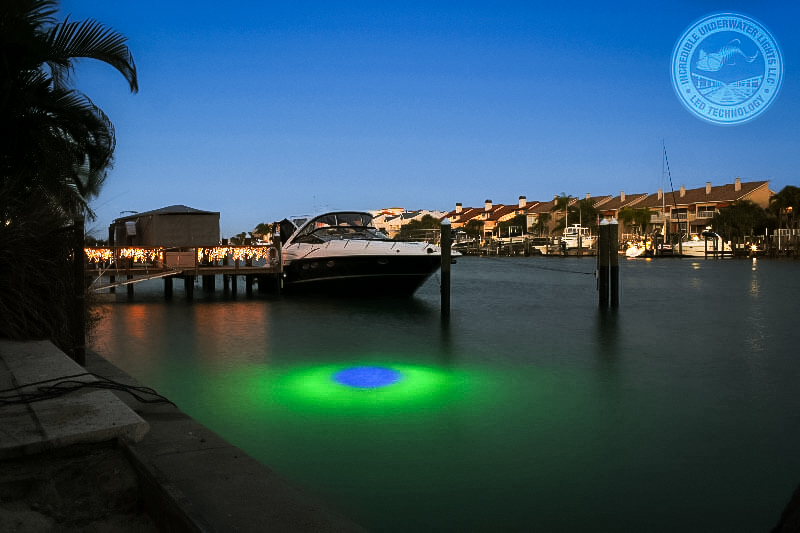
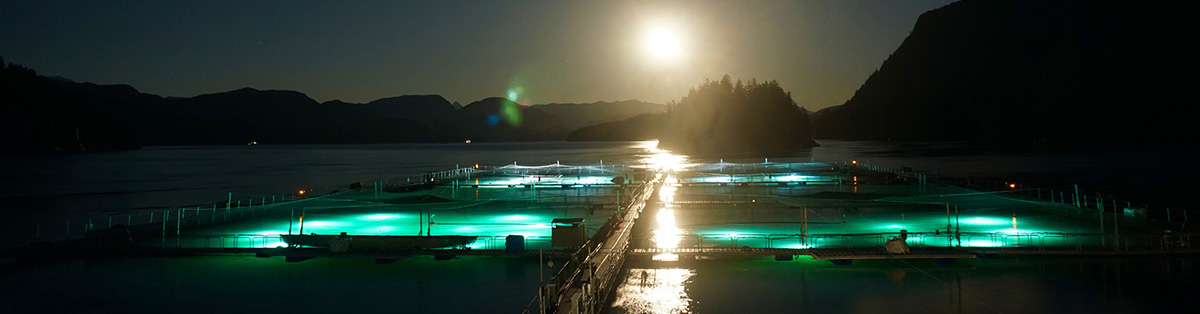
If you own a waterfront home, chances are you have spent at least one night staring out at the water and wondering what is moving around beneath the surface after dark. On inlet waterways especially, those tidal channels that run from the ocean into residential neighborhoods, the answer is a lot. And the right marine underwater lights can pull all of that life directly to your dock.
This guide is for waterfront homeowners who are curious but not yet sure where to start. We will cover how these lights work, what types are available, what installation looks like, and what you should actually think through before making a purchase.
Why Waterfront Homeowners Are Adding Underwater Lights to Their Docks
The idea is simple, and it works. When you install a marine underwater light on your dock, it creates a glow in the water that starts a chain reaction. Plankton and zooplankton are drawn to the light first. Small baitfish such as glass minnows, pilchards, and shrimp show up to feed on them. Then the bigger predators arrive to feed on the baitfish.
Within a few nights, you can have a thriving ecosystem forming right beneath your feet.
For homeowners on inlet waterways, this effect is particularly strong. These tidal channels carry natural fish traffic around the clock. Fish are already moving through your waterway and your dock light gives them a reason to stop and stay.
Lake homeowners see great results too. Bass, crappie, catfish, and walleye all respond well to underwater light. The same food chain principle applies whether you are on moving tidal water or a calm lake.
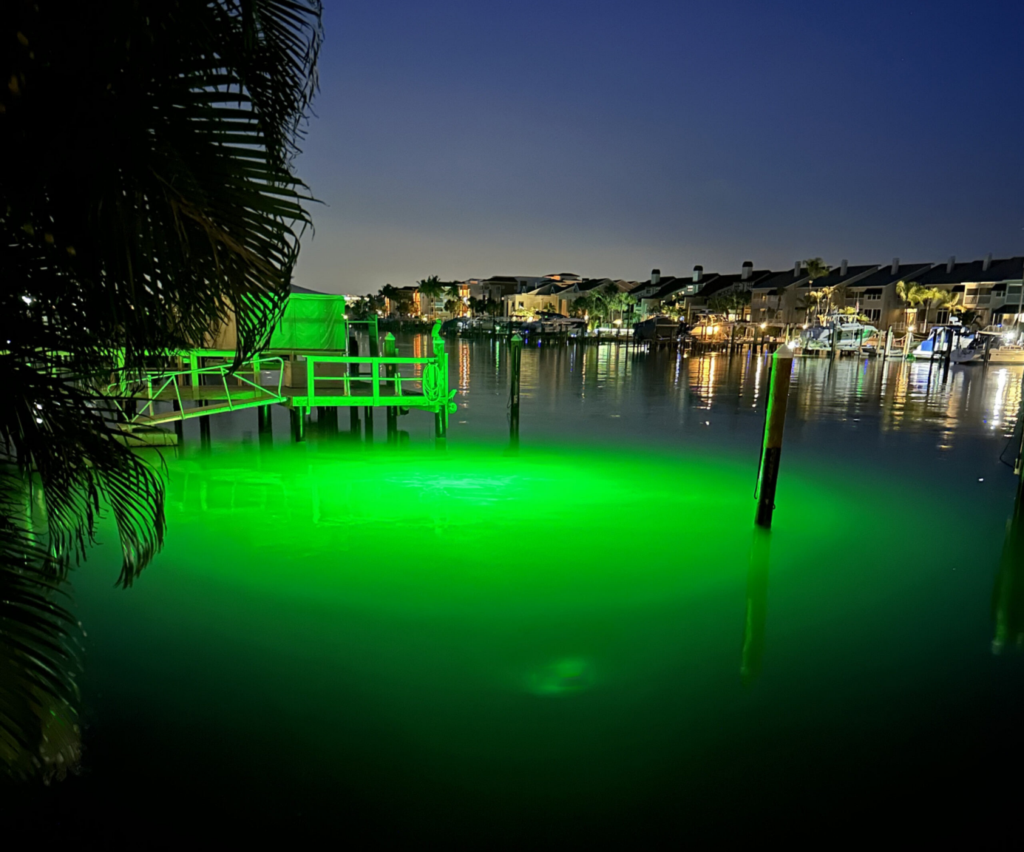
And honestly, even beyond the fishing, these lights are just beautiful. Watching hundreds of fish circling in a green underwater glow at night is an experience that is hard to describe until you see it for yourself.
What Are Marine Underwater Lights?
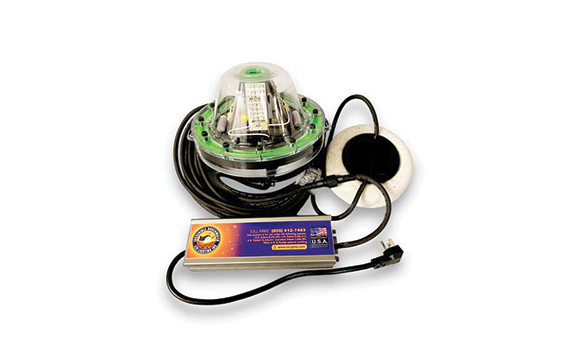
Marine underwater lights are submersible lighting systems designed to be mounted on docks or pilings and run continuously in saltwater or freshwater. They are built specifically for submerged operation in the conditions waterfront homeowners deal with every day.
The best systems today use LED technology. Underwater LED lights have replaced older systems because they are far more energy efficient, produce more usable light, and maintain consistent output over time. A modern LED system can generate an enormous amount of brightness on a fraction of the power older technologies required.
The most effective color for fish attraction is green. Underwater green lights work because green wavelengths (~520–560 nm) tends to penetrate coastal and clear ocean water more deeply than red or near-IR, and that particular wavelength is especially attractive to the zooplankton and baitfish that set off the whole food chain. This is why serious dock fishermen and inlet waterway homeowners almost universally go with green.
The Science Behind Underwater Fish Lights
How the Food Chain Gets Triggered
Underwater fish lights do not conjure fish out of nowhere. They work by triggering a natural food chain reaction, and once you understand the sequence, the results start to make a lot of sense.
Light attracts phytoplankton and zooplankton first. Microscopic organisms drawn instinctively to the glow. Baitfish show up next to feed on the plankton. Once baitfish gather in numbers, the predators follow. On inlet waterways, that means snook, tarpon, redfish, and speckled trout. On lakes, you are looking at bass, crappie, catfish, and walleye.
The result is a self-sustaining feeding zone that activates every night your light is on. Many dock owners describe it as a virtual aquarium beneath their dock, and that is genuinely what it becomes.
Why Inlet Waterways Produce Such Strong Results
Homeowners on inlet waterways tend to see the fastest and most dramatic results from marine underwater lights. These tidal channels already carry natural fish traffic. Fish are moving through your waterway with or without your light, but with a light, they stop.
The species variety on tidal inlets also adds to the experience. On any given night you might see snook cruising just beneath the surface, mullet jumping through the glow, shrimp collecting near the fixture, and smaller baitfish swarming in the column of light. It is an active, living scene that changes constantly.
What to Expect in the First Few Weeks
A lot of first-time buyers want to know what “working” actually looks like and when it starts.
The first night, you will likely see small baitfish and shrimp collecting near the light. That is the system doing exactly what it is supposed to do. The light attracts plankton, the baitfish follow, and the foundation of your dock ecosystem starts forming immediately.
By the end of the first week on most inlet waterways, the pattern is already establishing itself. Regulars start showing up. You might notice snook or trout cruising just outside the glow, waiting for baitfish to stray from the group. On lakes, bass and crappie tend to take a little longer to commit; usually one to two weeks before you see consistent predator activity.
Week two and three is where things get genuinely impressive. The baitfish population around your dock grows denser, the predator visits become more frequent, and the whole scene starts feeling less like a light in the water and more like a destination that fish are actively choosing to visit.
One thing worth knowing: consistency matters here. Leaving your underwater fish lights on through the night, every night, speeds this process up considerably. Fish learn patterns. The more reliable your light is, the faster they build a habit around it.
Underwater LED Lights: Why LED is the Right Choice
If you are comparing options, LED wins on almost every measure. Here is why underwater LED lights have become the clear standard for dock applications.
Energy Efficiency
High-quality LED systems can produce 25,000 lumens — an extraordinary amount of light — on as little as 80 watts of power. That is roughly equivalent to running two standard incandescent bulbs. If you plan to run your dock lights every night through the season, that energy difference is significant over time.
Light Quality
LED technology produces a consistent, clean output. Underwater green lights in LED format hold their color well and spread evenly through the water column rather than concentrating in hot spots. That even spread is what maximizes the attraction zone around your dock.
Long-Term Performance
With proper care and maintenance, LED systems perform well for many years. That matters for dock installations because replacing a submerged fixture is not a trivial job. A quality system that holds up is worth the upfront investment.
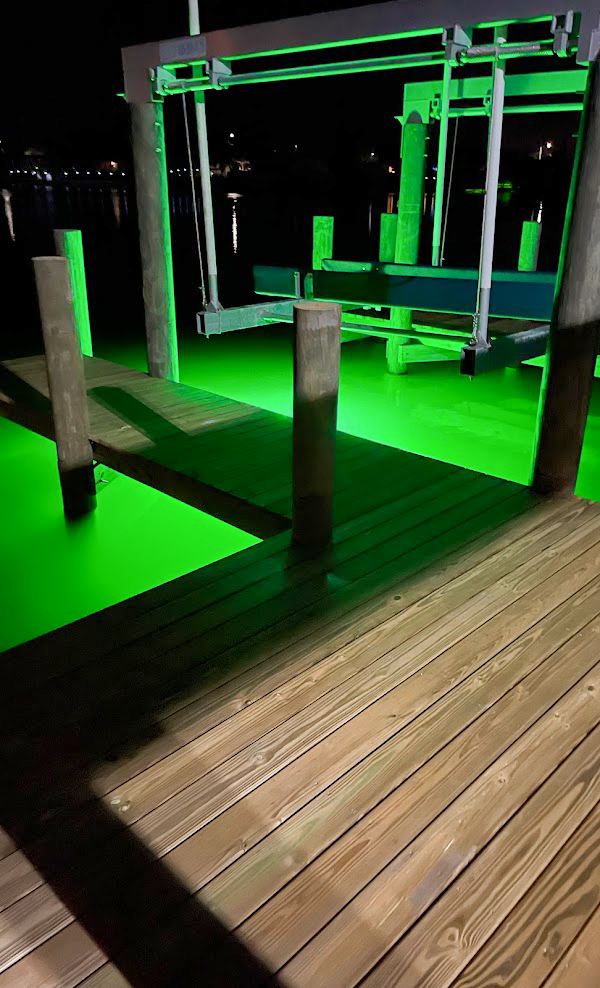
What to Think About Before You Buy
Where Your Dock Is Located
Location is the biggest factor in your results. Homeowners on inlet waterways consistently get the strongest returns from underwater fish lights because of the natural fish traffic those channels carry. If your dock sits on a tidal inlet, you are already in an excellent position.
Lake homeowners also do well, though the species and response time may differ. The key factors are water depth at the dock, reasonable water clarity, and some natural fish population in the area. Shallow or very murky water will limit what any light can do, regardless of how good the system is.
Lumen Output and Wattage
More lumens means a bigger attraction radius and a stronger food chain trigger. A 25,000-lumen system will outperform a lower-output light in terms of range and how quickly fish activity builds around your dock.
But high lumens should not automatically mean high power draw. The best underwater LED lights deliver exceptional output at low wattage. That combination is what separates a quality system from a basic one. When you are comparing products, look at lumens per watt.
Single Light vs. Multiple Lights
For most docks, a single well-placed marine underwater light is a strong starting point. Larger or more complex dock configurations like L-shaped docks, T-head docks, or docks with multiple slips may benefit from two or more fixtures to ensure coverage on all sides where fish can gather.
Think about where fish are most likely to approach from. On an inlet waterway, fish often travel in a consistent direction with tidal flow, so positioning your light to be visible to approaching fish is worth considering.
Mounting Depth
The light needs to be submerged deep enough to reach the water column fish are using, but not so deep that the glow is scattered or obscured. For most dock applications, mounting on a piling a few feet below the waterline is effective.
On inlet waterways with tidal fluctuation, account for how much the water level changes between high and low tide. A fixture that sits at an effective depth at high tide can end up partially exposed at low tide in some situations. This is worth checking before you finalize the mounting location.
Power Supply
Underwater dock lights need reliable electrical service at the dock. If your dock does not already have power, hiring a licensed electrician to run a circuit is the necessary first step before any light installation.
Any dock electrical installation should include a GFCI (ground fault circuit interrupter) on the circuit. This is a standard safety requirement and not something to skip.
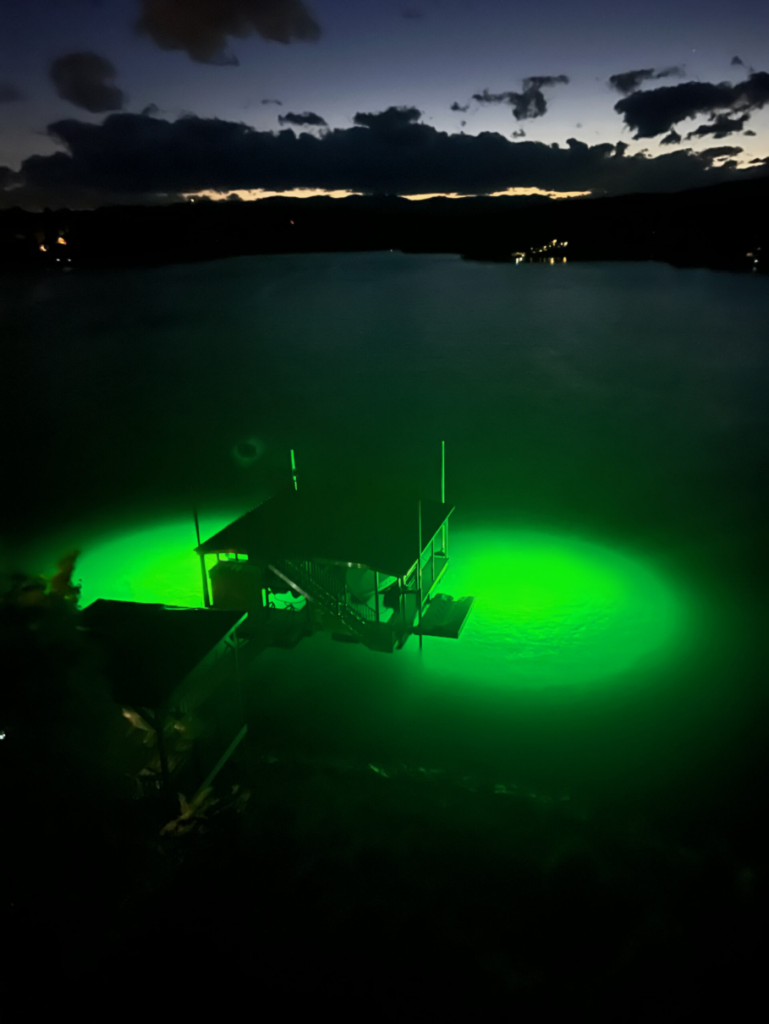
Installation: What the Process Actually Looks Like
Installing marine underwater lights is not complicated, but it needs to be done correctly. Here is a general walkthrough.
Step 1: Confirm electrical service at the dock
If you have working outlets on the dock already, you are ahead of the curve. If not, get a licensed electrician to run power first. This is the step that most commonly requires professional help.
Step 2: Choose your mounting location
Identify the piling or dock structure where the fixture will attach. On inlet waterways, think about visibility from the main direction fish approach. On lakes, prioritize the side of the dock with the most consistent water depth and open water exposure.
Step 3: Mount and connect the light.
Most quality underwater LED lights come with mounting hardware and clear instructions. The fixture attaches to the piling, the power cord routes up and along the dock structure to the connection point, and the light goes in the water. Cord connections should be kept above the waterline and protected.
Step 4: Test and observe.
Turn it on after dark and watch. Is the glow reaching the water column you expected? Is it visible from the directions you want fish to approach from? Small adjustments to depth or angle early on can make a real difference in long-term performance.
Give it a full week before you evaluate results. The food chain takes a little time to establish, and the first night is rarely the peak.
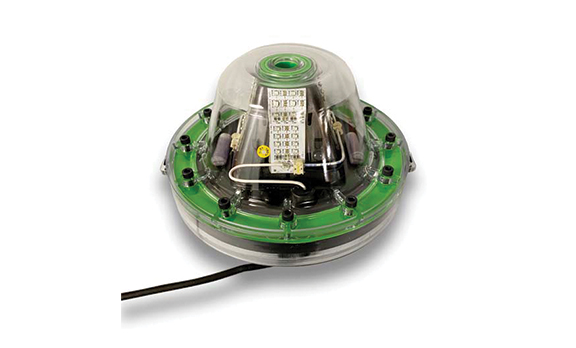
Maintaining Your Underwater Light
A little regular attention keeps your system performing at its best.
Clean the lens periodically. Algae and marine growth accumulate on the lens and reduce light output over time. A quick scrub every few weeks during the active season is usually enough.
Inspect the cord and connections. Look for any visible wear on the power cord, and confirm that connections above the waterline are secure. Address anything that looks damaged before it becomes a larger problem.
Check the mounting hardware each season. Hardware can loosen over time, especially in saltwater environments. A quick inspection and tightening keeps the fixture secure on the piling.
Rinse with fresh water after handling. If you pull the fixture out for maintenance and you are on a saltwater inlet, a fresh water rinse of the exterior goes a long way toward keeping it in good condition.
Things First-Time Buyers Need to Know Before Buying
How Long Until You’ll See Fish
Most inlet waterway homeowners report seeing baitfish within the first night or two. Larger fish typically follow within a week as the feeding pattern establishes. Lake results tend to be slightly slower, often taking one to two weeks for consistent activity.
Can You Leave The Light On All Night?
Yes, and you should. The most consistent results come from running your underwater fish lights continuously through the night. Fish learn the pattern and begin showing up reliably once they associate the glow with a food source. Irregular schedules slow that process down.
Underwater Marine Lights In Murky Waters
Water clarity matters. Clear water lets light spread further, which attracts organisms from a wider area. Moderately murky water still works, but with a smaller effective radius. Very turbid water significantly limits results for any marine underwater light.
Would You Need A Permit For Underwater Marine Lights?
It depends on your local jurisdiction and whether any structural modifications to the dock are involved. Electrical work typically requires permits in most areas. Check with your local building department if you are unsure.
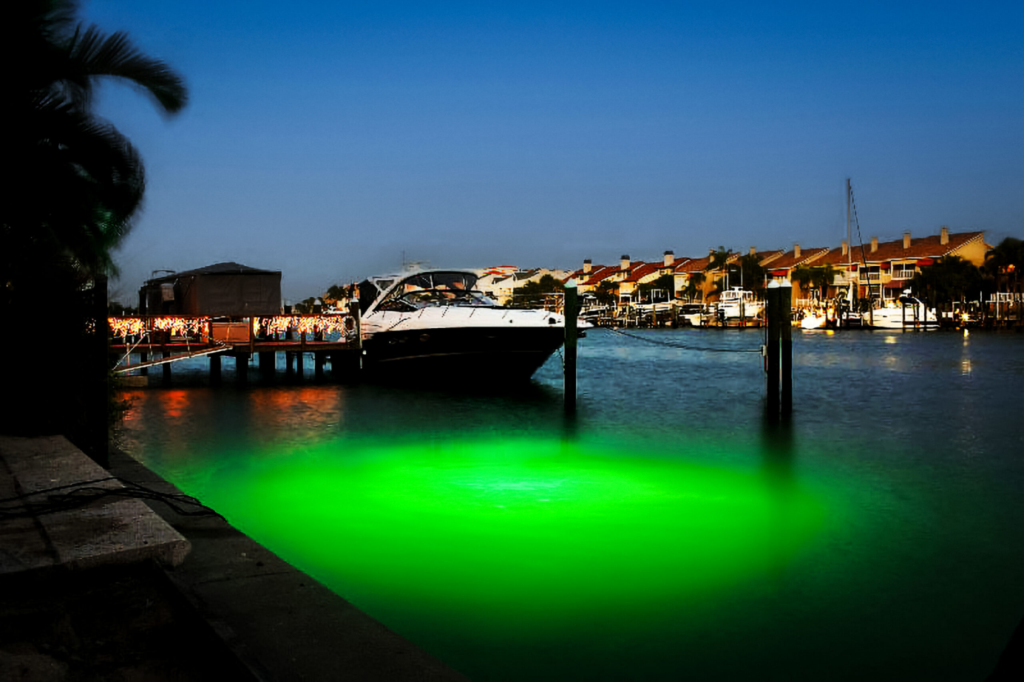
Ready to Light Up Your Dock?
If you live on an inlet waterway or a lake and you want real results under your dock, our marine underwater lights are built for exactly that.
Our 25,000-lumen underwater LED lights run on just 80 watts of power. This makes them the most energy-efficient systems in their class. Brilliant underwater light, without the shocking electricity bill.
Our underwater fish lights work by attracting baitfish first, and the larger predators follow. With proper care and maintenance, your system will deliver years of enjoyment, turning your dock into a living aquarium every single night.
Moreover, our underwater green lights are proven to perform on inlet waterways and lakes; precisely where our customers see the best results. If your dock sits on tidal water or a freshwater lake, this is the system that was made for you.
Contact us today to find the right setup for your waterfront property.
Frequently Asked Questions
How long do underwater lights last?
With proper care and maintenance, quality underwater LED lights last for many years. Keeping the lens clean, inspecting connections regularly, and rinsing saltwater exposure off the fixture after maintenance all help extend the life of your system significantly.
How many lumens for underwater marine lights?
For dock applications, 25,000 lumens is the benchmark to aim for. At that output, marine underwater lights create a wide enough attraction zone to trigger a strong food chain reaction. Pair that with low wattage, around 80 watts, and you have a genuinely efficient system.
What color light attracts the most fish?
Green. Underwater green lights attract the zooplankton and baitfish that larger fish feed on, which is what sets off the whole ecosystem around your dock. Fishermen on inlet waterways and lakes consistently get the strongest results with green over any other color.
What is the best color for underwater light?
Green is the top choice for underwater dock lighting. Underwater green lights penetrate water more effectively than other colors and trigger the plankton-to-baitfish food chain that attracts larger fish. For inlet waterways and lakes, green consistently delivers the best results.
