
Shopping Cart
The Ultimate Homeowner’s Playbook for Waterfront LED Lighting Success
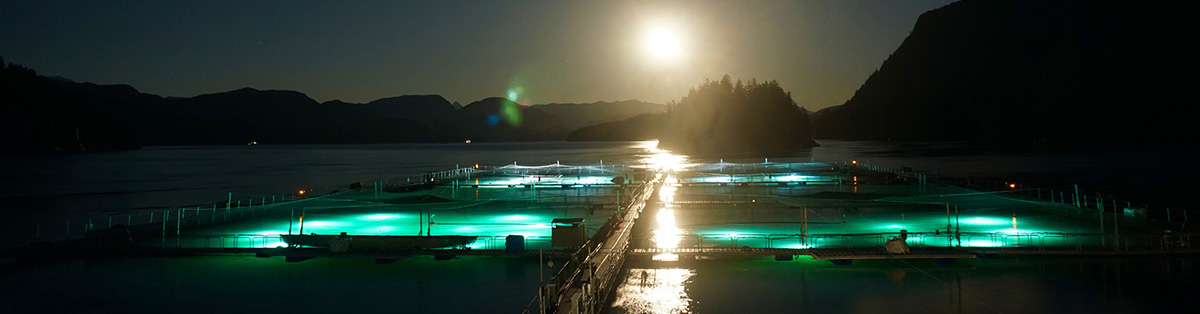
Waterfront living is one of life’s greatest luxuries—sunset views, relaxing waves, and the calm of outdoor evenings spent by the water. Yet, to maximize both the functionality and beauty of your dock or shoreline area, proper lighting is essential. Whether you’re aiming to enhance safety, highlight architectural features, attract fish, or create an inviting nighttime ambiance, today’s LED lighting technologies offer unprecedented performance and design versatility. Modern solutions, particularly marine underwater lights and underwater fish lights, deliver exceptional brightness with minimal energy consumption, making them ideal for long-term waterfront use.
This comprehensive playbook is designed to equip homeowners with everything they need to achieve waterfront lighting success with LED dock lighting.
Understanding the Purpose of Waterfront Lighting
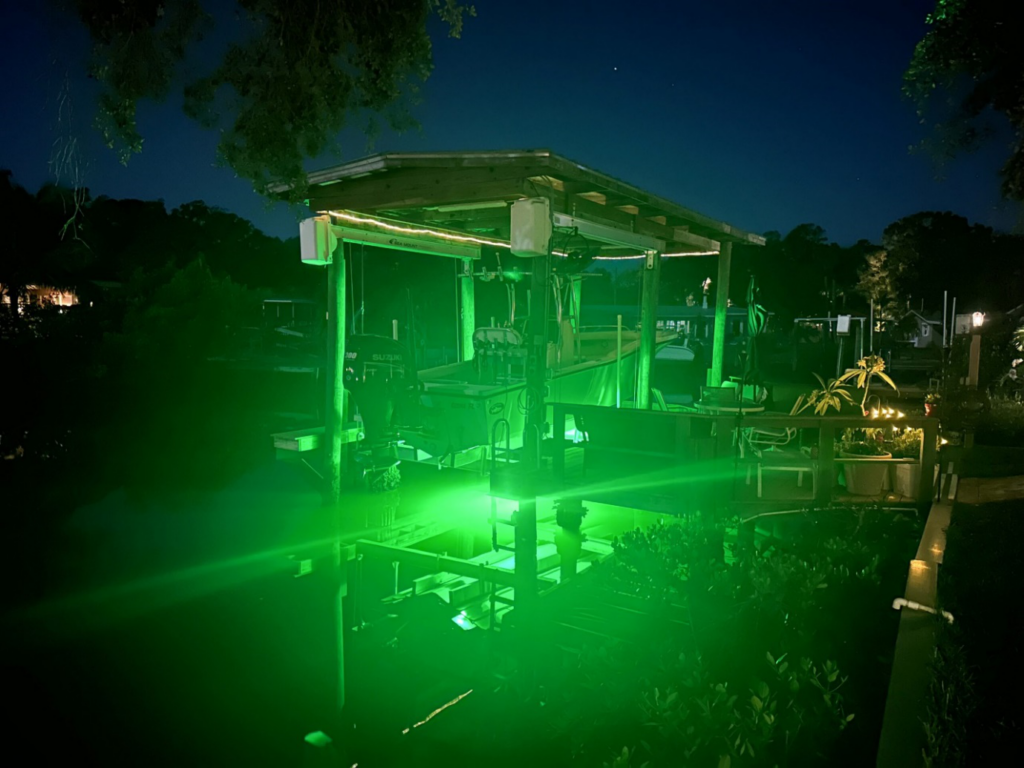
Before choosing fixtures or planning installation, homeowners should develop a clear understanding of why they are adding lighting. Waterfront lighting serves three primary purposes: safety, aesthetics, and utility.
Safety First: Mitigating Risk on the Waterfront
Docks are high-risk environments, especially after dark. Wet surfaces, uneven planks, moving boats, and low visibility increase the chance of slips and falls. LED dock lights, underwater lights, and pathway illumination make navigation safer for family, guests, and boaters.
Key safety goals include:
Marking Edges and Transitions: This is the most critical safety function. Recessed or surface-mounted lights should clearly outline the perimeter of the dock, especially where it meets the water, and illuminate any changes in elevation or direction (e.g., L-shaped sections).
Lighting Stairs, Ramps, and Uneven Surfaces: Every step, incline, or potential tripping hazard must be clearly visible. Consider fixtures that cast light down onto the surface rather than horizontally, which minimizes glare while maximizing surface illumination.
Illuminating Mooring Points for Nighttime Docking: For boat owners, clear lighting at the pilings and cleats is essential. This task-specific lighting allows for safe, accurate docking regardless of ambient conditions.
Enhancing Visibility During Storms, Tides, or Low-Light Conditions: Reliable, fully-sealed, and sometimes motion-activated lighting provides peace of mind when weather conditions deteriorate unexpectedly.
Aesthetic Enhancement: Designing the Nighttime Landscape
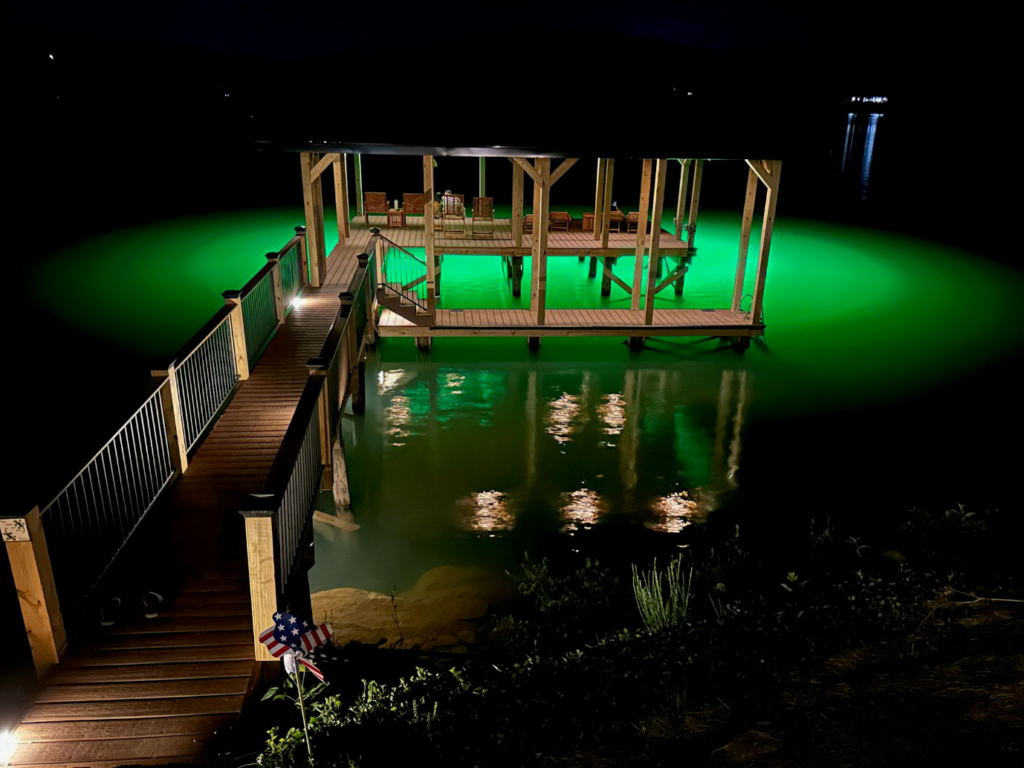
Lighting is one of the most powerful design elements for creating memorable waterfront experiences. It transforms an ordinary dock into a stunning evening retreat. The goal is often referred to as “architectural landscape lighting,” extending the home’s living space to the water’s edge.
Strategic lighting can:
Highlight Pilings, Walkways, and Railings: Using narrow-beam spotlights or carefully positioned post-cap lights draws attention to the structural beauty of the dock.
Illuminate the Water for Visual Depth: Underwater lights are the primary tool for this. The illuminated water column adds depth, movement, and a unique focal point that is impossible to achieve with land-based lighting alone.
Create Soft, Ambient Glow During Gatherings: This is achieved through indirect lighting, where light sources are hidden, and the light is reflected off surfaces, resulting in a low-glare, inviting atmosphere.
Make Your Home Look More Inviting from Across the Water: The light from the dock acts as a visual anchor, extending the property’s perceived size and luxury.
Functional Utility: Practical Applications

Waterfront homeowners also rely on lighting for practical purposes, such as:
Nighttime Fishing: Specific light colors (Green) attract baitfish, which in turn attract game fish. This transforms the dock into an active fishing location.
Boat Cleaning and Maintenance: Focused, bright task lighting is necessary for safe work on the vessel without needing to rely on weak onboard lights.
Gear Organization: Clear illumination of storage boxes and access points makes preparing for a day on the water efficient and safe.
Entertaining Guests on the Dock or Patio: Sufficient, dimmable ambient lighting ensures guests are comfortable and safe when moving around.
Underwater LED lights, in particular, support multiple use cases because they attract fish, improve visibility, and create an unmistakable upscale aesthetic.
Planning a Lighting Layout That Works

Designing a waterfront lighting plan requires balancing brightness, placement, and functionality. The process should mimic professional landscape design, where utility and visual impact are prioritized equally.
Evaluate Your Dock’s Structure and Environment
Begin by examining:
Size and Shape of the Dock: Linear docks require simple path lighting; T-shaped or complex docks require careful layering to avoid confusion and dark spots.
Water Depth and Clarity: Deeper, clearer water is ideal for powerful underwater green lights to showcase the depth; shallow, murky water may require more lights placed closer to the surface.
Slip Configurations: Task lighting must be precisely placed to aid in safe boat maneuvering.
Walkway Pathways: Determine primary traffic routes for safety lighting placement.
Proximity to the Shoreline: This determines if the lighting needs to integrate with the home’s overall landscape lighting design.
Understanding these factors helps determine where and how many lights to install.
Avoid Overlighting: The Glare Factor
Overly bright docks can cause:
Glare on the Water: Blinding light reflecting off the water surface, ruining the view and hindering navigation.
Light Pollution: Disrupting the local environment and annoying neighbors.
Difficulty Adjusting Vision After Dark: Too many bright lights can prevent the human eye from adapting to surrounding darkness.
Rule of Thumb: Aim for strategic placement rather than excessive wattage. Use lower-wattage fixtures placed closer together to create even illumination, instead of fewer high-wattage lights that create bright hotspots and deep shadows.
Professional Installation vs. DIY Setup

Homeowners often wonder whether to hire a professional or install dock lights independently. The decision largely depends on the complexity of the system and, critically, the voltage involved.
Benefits of Professional Installation: Safety and Longevity
Working with a certified installer, preferably one specialized in marine electrical systems, ensures:
Correct Wiring and Voltage: Professionals understand the unique challenges of wiring near water, especially the need for Ground Fault Circuit Interrupter (GFCI) protection and correct voltage drop calculations over long dock runs.
Proper Waterproof Sealing and Encapsulation: Ensuring all connections are fully sealed against humidity and immersion is the single biggest factor in the longevity of marine lighting.
Safe Placement Around Water: Adherence to the National Electrical Code (NEC) and local marine codes, which often dictate minimum distances from the waterline and required conduit types.
Compliance with Local Code: Avoiding fines or mandatory removal of non-compliant fixtures.
Long-Term Reliability: Warranties and guaranteed installation standards.
Professionals also help optimize the lighting layout for aesthetics and performance, ensuring the right amount of light is used in the right places.
Energy Efficiency and Cost Benefits of LEDs

One of the most compelling advantages of modern dock lighting is the exceptional energy efficiency of LEDs.
Lower Energy Consumption: The Efficiency Equation
LEDs use up to 80 percent less electricity than traditional halogen or incandescent bulbs. This difference is starkly apparent in waterfront environments where lights are often required to be on all night, every night.
A typical 500-watt halogen floodlight can be replaced with an LED floodlight consuming only about 75-100 watts, representing massive, immediate energy savings.
Longer Lifespan: Reduced Maintenance Burden
High-quality LEDs can last 30,000 to 50,000 hours or more. This dramatically reduces maintenance, especially for underwater lights that are difficult to access. A system running for 10 hours a night will last well over 8 to 13 years before needing replacement, compared to just 1 to 2 years for traditional bulbs.
Reduced Replacement Costs: The Lifecycle Value
While the initial cost of an LED fixture is higher than traditional lighting, the total cost of ownership is far lower. LED fixtures require fewer bulb changes, resulting in decreased long-term costs for materials and labor. For complex underwater installations, this elimination of routine bulb replacement is invaluable.
Environmentally Friendly Operation
LEDs emit less heat (reducing their impact on water temperature and localized marine life), contain no toxic mercury (unlike fluorescent bulbs), and produce carbon emissions over their lifespan, making them a sustainable choice for eco-conscious homeowners and a better neighbor to the environment.
How Underwater LED Lights Attract Fish: The Wavelength Advantage
Homeowners who enjoy nighttime fishing often choose underwater LED systems specifically designed for fish attraction.
The science behind fish attraction involves the behavior of the aquatic food chain:
Certain Wavelengths (especially Green): Green light penetrates water with the least energy loss, traveling deepest and furthest in most water conditions. This specific wavelength stimulates the growth and congregation of zooplankton and phytoplankton.
Plankton Attracts Baitfish: The microscopic plankton are the primary food source for small schooling fish, often called baitfish (e.g., minnows, shrimp, squid). These baitfish are drawn into the concentrated light column to feed.
Baitfish Attract Larger Game Fish: The presence of a high concentration of baitfish creates a highly visible, easy-to-access feeding opportunity for larger game fish (e.g., Snook, Tarpon, Bass). The game fish cruise the edge of the illuminated area, using the light for cover and visibility while waiting for an easy meal.
Strategically placed underwater lights can transform your dock into a dynamic fishing hub, often resulting in spectacular nighttime fishing. The power (Lumen output) of the light determines the size of the illuminated zone and, thus, the size of the feeding frenzy.
Enhancing Curb Appeal and Property Value
Waterfront lighting is more than functional—it also enhances property value by maximizing the use and visual appeal of the most valuable part of the property: the waterfront itself.
Visual Impact from the Water and Shoreline
A professionally lit dock, especially one featuring vibrant underwater illumination, significantly increases the property’s night curb appeal. Glowing water and illuminated dock edges make your home more appealing to guests and passersby, communicating a sense of luxury, safety, and meticulous upkeep. It turns the dock into a visual extension of the home’s architecture.
Increased Safety and Accessibility
Improved safety features are highly attractive to potential buyers and appraisers. A modern, compliant, and clearly illuminated dock is seen as a low-risk, high-utility feature. The inclusion of low-voltage systems and GFCI-protected circuits is a mark of quality and modern construction, contributing positively to the property assessment.
Long-Term Investment
High-quality LED systems pay for themselves in energy savings, longevity, and curb appeal. The perceived value of a fully operational, beautiful lighting system often exceeds its actual cost when selling the property.
A beautifully lit dock stands out during nighttime showings, evening events, and waterfront tours, making a powerful, lasting impression on prospective buyers.
Maintenance Tips for Long-Term Performance: Fighting the Elements
Consistent maintenance ensures reliability and brightness in the unforgiving marine environment. The biggest enemies of dock lighting are corrosion, marine growth, and prolonged exposure to UV and moisture.
Clean Fixtures Regularly
Salt, algae, mineral buildup, and dust can significantly dim light output by clouding the lens. Wipe lenses gently with a marine-safe cleaner (pH-neutral soap) and a soft cloth, ideally every 4-6 weeks, or more frequently in high-salt areas.
Inspect for Marine Growth (Fouling)
Underwater fixtures often accumulate barnacles, algae, and slime (biofouling). This growth acts like a heavy curtain, severely reducing light transmission.
Removal: For accessible lights, remove growth carefully using a non-abrasive tool (like a plastic scraper or a soft brush) to avoid scratching the light’s lens or protective coating.
Prevention: Some fixtures have anti-fouling coatings. Check manufacturer specifications. In severe cases, a diver or maintenance crew may be required for deep-water lights.
Check Wiring, Mounting, and Hardware
Look for corrosion or loose connections, especially in saltwater environments. Replace any hardware that shows signs of rust (e.g., screws, brackets) with marine-grade stainless steel ($316 \text{ SS}$) alternatives. Ensure cable glands and conduit entries remain tightly sealed. Any exposed wire insulation should be immediately repaired with marine-grade heat-shrink tubing and electrical sealant.
Perform Night Inspections
Once a month, view your dock after dark to:
Identify Dimming: A dim light may indicate a failing seal, incoming water intrusion, or a corroded connection.
Notice Flickering: This often signals a loose or failing connection in the low-voltage line.
Confirm Adequate Coverage: Ensure no critical safety area has lost illumination.
Replace Components Before Failure
When one light fixture in a series begins to fail, it often indicates a systemic issue, such as an aging power supply or voltage instability. Early replacements of these components protect the integrity of the entire system and prevent cascading failures.
Common Mistakes Homeowners Should Avoid
Even well-intentioned lighting plans can fall short when simple mistakes occur.
Using Indoor or Generic Outdoor Fixtures Outdoors
Indoor fixtures are not rated for marine environments and will corrode or fail quickly due to moisture, salt, and UV exposure. Always verify the fixture’s IP rating and confirm it is explicitly rated for wet locations or marine environments.
Choosing Low-Quality LEDs
Cheap lights may save money upfront, but use inferior components, leading to:
Premature Failure: Due to poor heat dissipation and non-marine grade internal wiring.
Color Shift: Loss of the desired color temperature over time.
Poor Waterproofing: Inadequate seals leading to water damage.
Invest in fixtures from reputable marine lighting manufacturers for long-term value.
Overlooking Voltage Requirements and Voltage Drop
Incorrect voltage can cause dangerous overheating or system failure. For low-voltage systems, failing to account for voltage drop over long runs can result in the last lights in the line being noticeably dimmer than the first. This requires a thicker wire gauge or the use of multiple shorter runs from the transformer.
Ignoring Glare
Harsh, upward-facing lighting ruins night vision and detracts from waterfront enjoyment. Glare is a sign of poor fixture placement or improper beam angle. Use baffled fixtures, low-profile designs, or light sources that shine down onto the surface.
Installing Lights Too Close Together or Too Far Apart
Spacing issues create unbalanced illumination. Too close creates unnecessary “hotspots”; too far apart leaves dim or dark pockets, compromising safety. Follow the “Rule of Thumb” for spacing: the distance between fixtures should be approximately $1.5$ to $2$ times the mounting height for even coverage.
Real Tips for Lighting Your Dock Like a Professional
Below are practical, high-value tips homeowners can use immediately to elevate their lighting design from basic to professional grade.
Tip 1: Light the Path, Not the Water Surface
Install path and deck lights low (e.g., recessed into the deck) and direct the light downward (known as ‘cove’ or ‘grazing’ lighting). This illuminates the walking surface clearly while preventing light from reflecting harshly off the water and causing glare.
Tip 2: Combine Underwater Lights with Edge Lights
Using perimeter surface lights (deck lights) and underwater lights together creates depth, contrast, and enhanced safety. The surface light defines the boundary, while the underwater glow adds dimension, making the dock feel less like a platform floating in the dark.
Tip 3: Install Lights at Multiple Depths (If Feasible)
For long-term residents, installing lights at multiple depths can be beneficial. Shallow lights illuminate the immediate structure and the water surface; deeper lights enhance water clarity and volume, creating a mesmerizing gradient effect.
Tip 4: Use Marine-Grade, Corrosion-Resistant Materials Only
This is not a tip—it is a requirement for longevity. Specifically use $\text{316L}$ stainless steel (L stands for low carbon, which resists corrosion in welds) or brass/bronze alloy fixtures. Avoid $\text{304}$ stainless steel or standard aluminum, especially in saltwater.
Tip 8: Start Small, Expand Over Time
Lighting can be installed in layers to avoid overwhelming the budget. Begin with essential safety lighting (deck perimeter), then add ambient lighting (post-caps), and finally, invest in the signature underwater system.
Tip 9: Use Dimmable LEDs for Flexibility
Dimmable LEDs are non-negotiable for modern lighting. Different settings suit different functions: high brightness for cleaning, medium for entertaining, and low/dim for quiet evenings or stargazing.
Conclusion: Your Blueprint for Waterfront Lighting Success
Achieving gorgeous, functional, and efficient waterfront lighting is a blend of thoughtful planning, the right equipment, and consistent upkeep. Modern LED systems—especially underwater LED lighting, post-mounted fixtures, and low-profile LED dock lighting solutions—give homeowners the ability to create safe, welcoming, and visually captivating spaces that enhance both everyday living and long-term property value.
Illuminate Your Waterfront with Incredible Underwater LED Lighting
Transform your dock with premium underwater LED lights, underwater dock lights, and underwater green lights that enhance beauty, safety, and fish activity. Incredible Underwater LED Lighting delivers marine underwater lights and underwater fish lights for unforgettable nights on the water. Upgrade your waterfront today and contact us to get started.
Frequently Asked Questions
1. What are dock lights used for?
Dock lights are used to illuminate docks, piers, and waterfront areas for safety, visibility, and aesthetics. They help prevent accidents, guide boats at night, highlight dock features, and can also attract fish when installed underwater.
2. What do you mean by LED lighting?
LED lighting refers to light-emitting diode technology, which produces light efficiently by passing electricity through a semiconductor. LEDs consume less power, last longer, and provide brighter, more focused illumination compared to traditional bulbs.
3. Why is everyone switching to LED lights?
LED lights are energy-efficient, durable, and environmentally friendly. They reduce electricity costs, require fewer replacements, generate minimal heat, and can operate in challenging environments like docks and underwater areas.
4. What are the examples of LED lighting?
Examples include underwater LED lights, LED dock lights, strip lighting, recessed deck lights, landscape path lights, floodlights, and smart LED fixtures for both residential and commercial applications.
